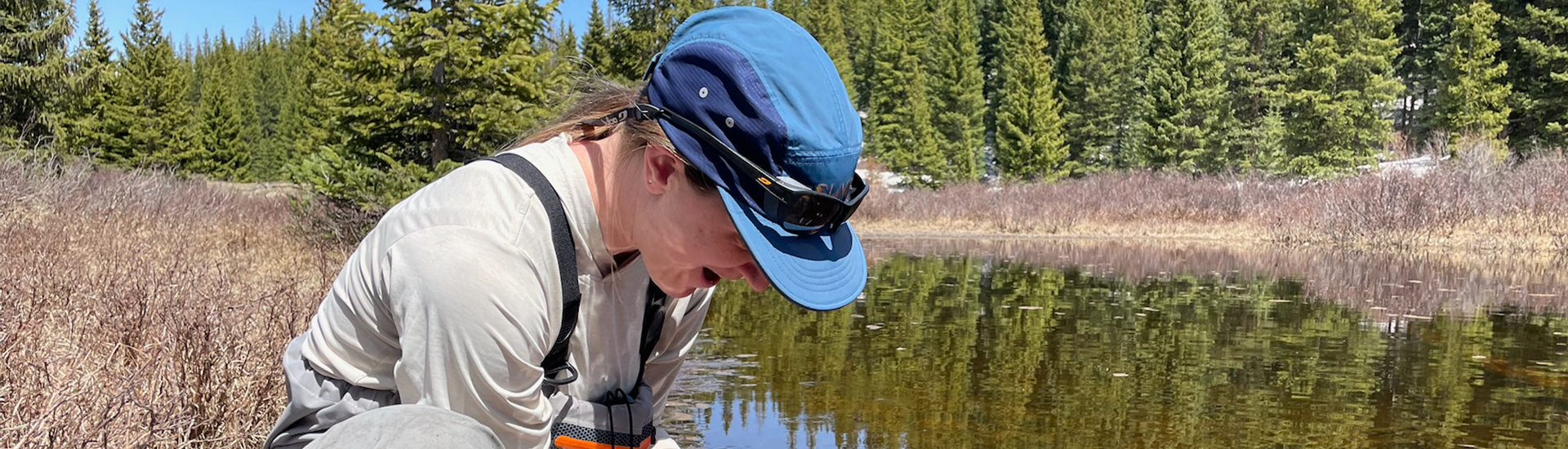
When traversing nearly any landscape, there is a diverse amount of life to discover. For Northern Arizona University assistant professor Anne Chambers, that diversity is meant to be explored, not just observed.
“I was always fascinated by biodiversity,” Chambers said. “I was always intrigued by what forms the sheer amount of variation in the natural world, in different types of birds, different species of reptiles and amphibians and what sort of forces work to generate it.”
In addition to teaching biology at NAU’s Department of Biological Sciences, Chambers is the school’s Vertebrate Collection curator. Focusing on evolutionary and wildlife biology, herpetology, biodiversity and conservation genomics, she uses her genetic research to learn how species and populations are related.
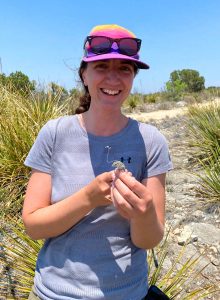
“There’s this evolutionary force that’s ongoing, that shapes all this diversity around us,” Chambers said. “It’s kind of this invisible thing that we have to figure out ways to quantify and measure and observe.”
Knowing biodiversity has existed for millions of years, Chambers understands that finding out what’s happening requires genomics-based tools to learn the patterns and processes that drive Earth’s biodiversity.
“My research is kind of thinking about two big questions,” Chambers said. “The first question is sort of deceptively simple, which is just if there are two different groups of animals, do they belong to the same species or to different species?”
Answering that question can involve species delimitation, a process used to determine where one species ends, and another starts. Genomic data can display evidence about how populations are related and how they change with time.
Those findings can carry consequences beyond evolutionary research. Identifying distinct populations can inform scientists about which groups might need more conservation attention.
For Chambers, that link between understanding and conserving biodiversity is particularly important in Arizona, where drastically different landscapes provide opportunities to study biodiversity and how populations have adapted to varying environments.
“The second sort of facet of my work is thinking about how we can conserve these populations that we’ve now described,” Chambers said.
The curator is especially passionate about reptiles and amphibians. She notes that their cold-blooded, stationary nature coupled with the changing environments make them remarkably interesting to study.
“Arizona is a very fascinating place from a landscape perspective,” Chambers said. “There’s so many different ecoregions or sets of environments within the state, and correspondingly, there’s so much interesting biodiversity in Arizona.”
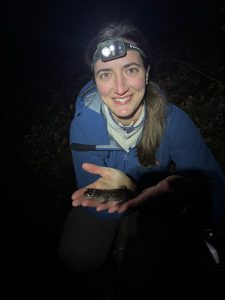
For Chambers, it’s crucial to understand these differences as scientists strive to conserve biodiversity. Her research aims to reveal relationships between populations and share a clearer picture of what Earth could lose when species or genetically distinct populations vanish.
“It’s critical for the community and members of the public to really value their wild spaces and the wildlife that occurs here, and work to protect it as best they can,” Chambers said. “If these things go extinct and they disappear from the landscape, it will affect you as a person as well. You’ll see a cascade of effects, so it’s important for people to think a bit more about that.”
Through her discoveries and teaching at NAU, Chambers hopes to better understand the process behind biodiversity and to educate others about its value. For her, studying individual vertebrates can help the public understand how the natural world became as diverse as it is now, and what they can do to defend that diversity.
The Vertebrate Collection and the Chambers Lab can be found at NAU’s Biological Sciences building. To learn more about her work from the California Conservation Genomics Project and beyond, click on the links attached.
Interviewed and written by Dominic Borja