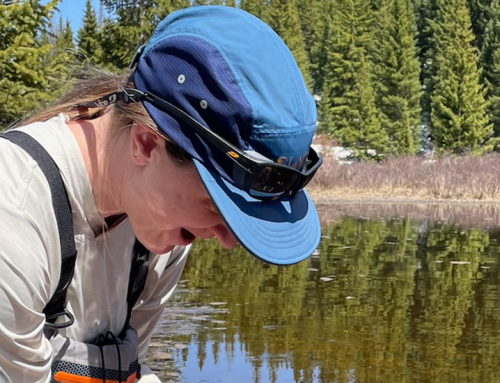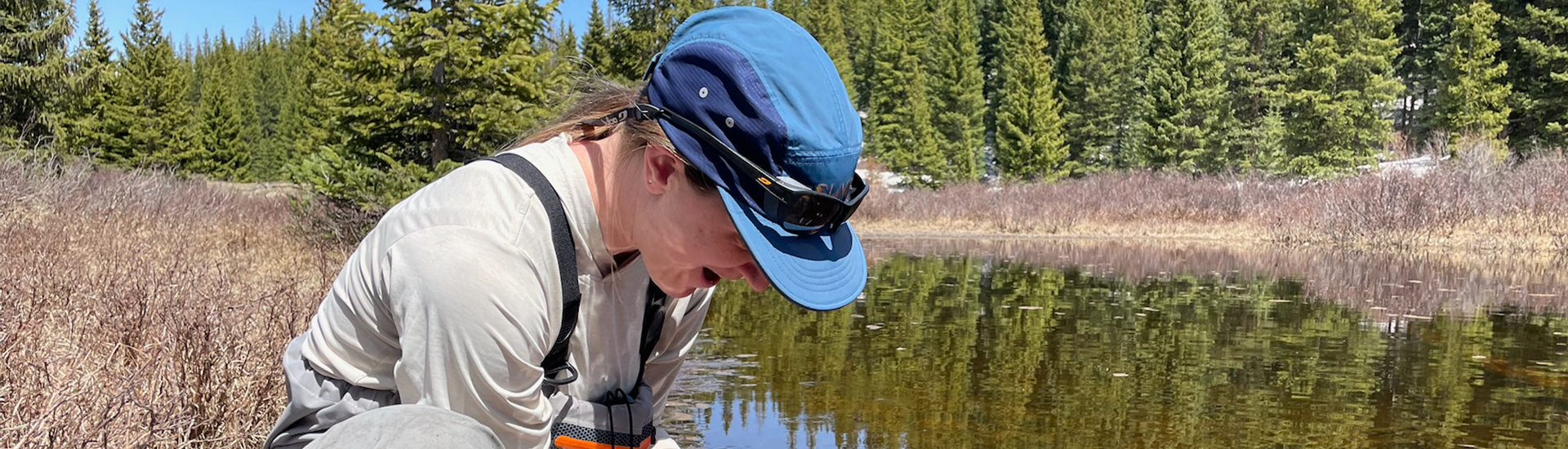
When Rae Kursky thinks about the water cycle, she pictures more than evaporation, condensation and precipitation. She thinks about the impacts water movement has on environments and communities.
“I was working with Conservation Legacy, an AmeriCorps organization out of Flagstaff,” Kursky said. “We were drawing our water just fine, but on day five, the stream totally went dry. It just made me have a personal experience of what a lot of people around the world go through of being dependent on water sources directly, not just from a faucet.”
That experience of learning what streams do and where people get their water from inspired the Flagstaff native to study hydrology at Northern Arizona University. While pursuing her bachelor’s degree in geology, Kursky became passionate about finding a way to make more potable water.
“They say less than 3% of water on Earth is potable for drinking, and I just found that to be absurd,” she recalled. “That’s really what made me interested and passionate about it. The more I learn, the more questions I have, the more interest I gain, so it’s only grown since then.”
Today, Kursky works as a hydrologist for the National Oceanic and Atmospheric Administration’s National Water Center in Tuscaloosa, Alabama. She helps monitor the streams that suddenly disappear, the storms that can transform watersheds overnight and the countless paths a single drop of water can take. For Kursky, her favorite part of her research is the extensiveness hydrology and the process of learning the complete picture.
“Hydrology is super broad,” Kursky said. “There’s a lot of avenues to study within hydrology, like civil engineering, public policy, natural resource planning and geology. I wanted to understand the whole picture.”
That broad perspective shapes her current work at NOAA. The National Water Center brings information from river forecast centers across the country, where hydrologists compare forecasts, analyze models and coordinate messaging before floods and other hazardous events. The work combines weather forecasts, streamflow observations and computer models to help communities prepare for changing conditions.
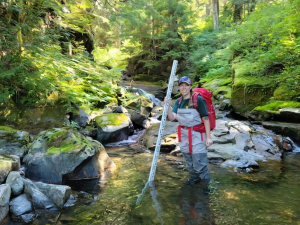
Kursky says while people today have a better grasp on the water cycle, one of the biggest misconceptions about water is that it follows a simple loop. She views the sequence as a particle science, where each particle of water interacts with its surroundings differently from each other.
“It’s kind of a vector science rather than a simple cycle that we learn about in school,” Kursky said. “It’s not just a piece of rain that hits a watershed on top of a mountain and flows down and eventually gets to the ocean. It could just hit the ground, infiltrate and stay underground in the aquifer, or it could freeze or sublimate.”
Growing up in Flagstaff gave Kursky a lasting appreciation for the region’s water resource department. She points to the city’s focus on conservation efforts and the use of snowpack in sustaining northern Arizona’s water supply. The Tuscaloosa resident also applauded Flagstaff for educating the public about the surrounding landscapes without fearmongering.
“Everyone should care about the water, not just because of the obvious, but it’s also super fun,” Kursky said. “It’s a science that has so many questions. It’s an endless study.”
Interviewed and written by Dominic Borja