A robot does not always move the way its creator expects. Sometimes it falls, malfunctions or simply refuses to work. For Reza Razavian, those failures are not setbacks, but instead opportunities for scientists to learn.
Razavian, an assistant professor of mechanical engineering at Northern Arizona University, researches the connection between sensory-motor neuroscience and robotics. His work examines how the human brain controls movement and how robots can be designed to replicate some of those abilities.
“Robotics is one a field that you learn about and excel at by just reading textbooks and theory,” Razavian said. “It’s a physical thing, so you need to get hands-on, be in the lab and work with the hardware, software and programming.”
That hands-on approach is central to the professor’s research and teaching. In his lab, students build and test robotic systems, learning from what works and what does not.
“We are dealing with a problem nobody has solved before,” Razavian said. “99% of the time we are learning through failure.”
For him, failure and scientific discovery are intertwined. Researchers can encounter hundreds of unsuccessful approaches before finding one that provides useful information.
“The only way to walk into this unknown environment that research is through exploration, trial and error,” Razavian said. “The only way we can create something new is through experiencing things that nobody has experienced before.”
Some of that exploration has practical applications in rehabilitation. Razavian is developing robotic technology designed to help people regain motor movement after suffering from conditions like spinal cord injuries or strokes. The technology could provide opportunities for people to repeatedly practice movements at home, supplementing time spent in physical therapy.
The lab director hopes students who interact with robotics will see that the field extends beyond building machines. Robotics can combine mechanical design, programming, neuroscience, biology and other disciplines.
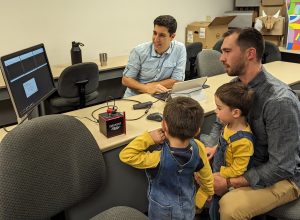
“The biggest goal of this workshop is introducing the very broad field of robotics to the mostly younger kids, but also their parents,” Razavian said. “We hope to make all participants excited to learn robotics.”
Razavian has a simple message for students who are curious about robotics but do not see themselves as engineers.
“Not everybody needs to be an engineer to enter robotics,” he said. “People should continue their passion, whatever field it is, and find those connections between that field and robotics.”
Razavian’s hands-on robotics workshop takes place on Oct. 3 from 10 a.m. to noon at Room 106A of NAU’s Learning Resource Center. To learn more about his work at NAU and beyond, click the links attached.
Interviewed and written by Dominic Borja