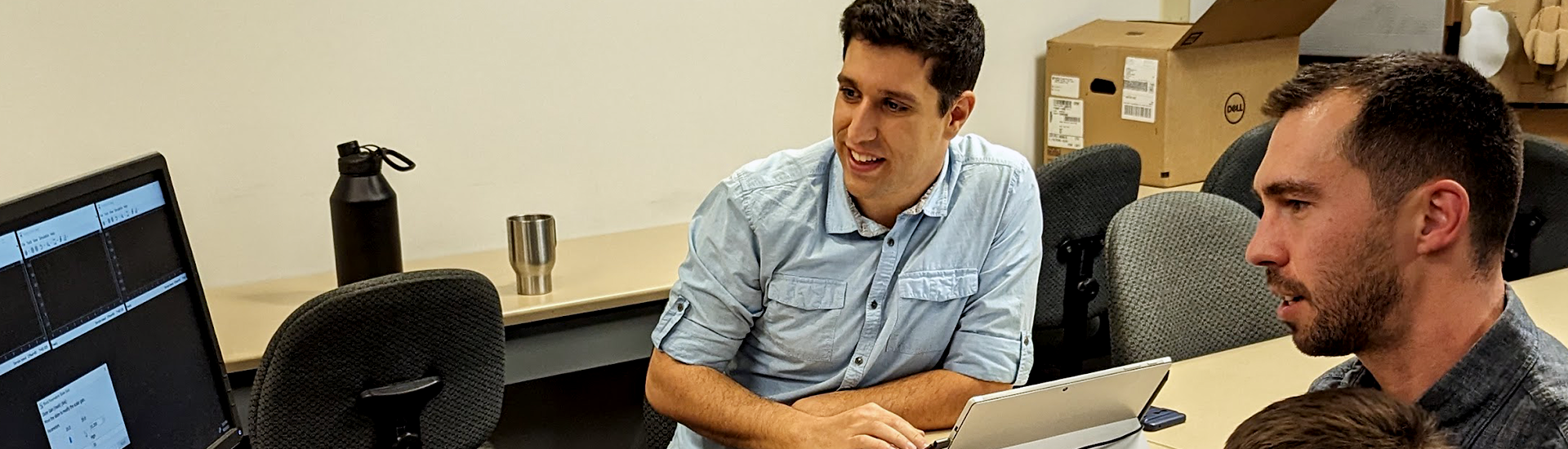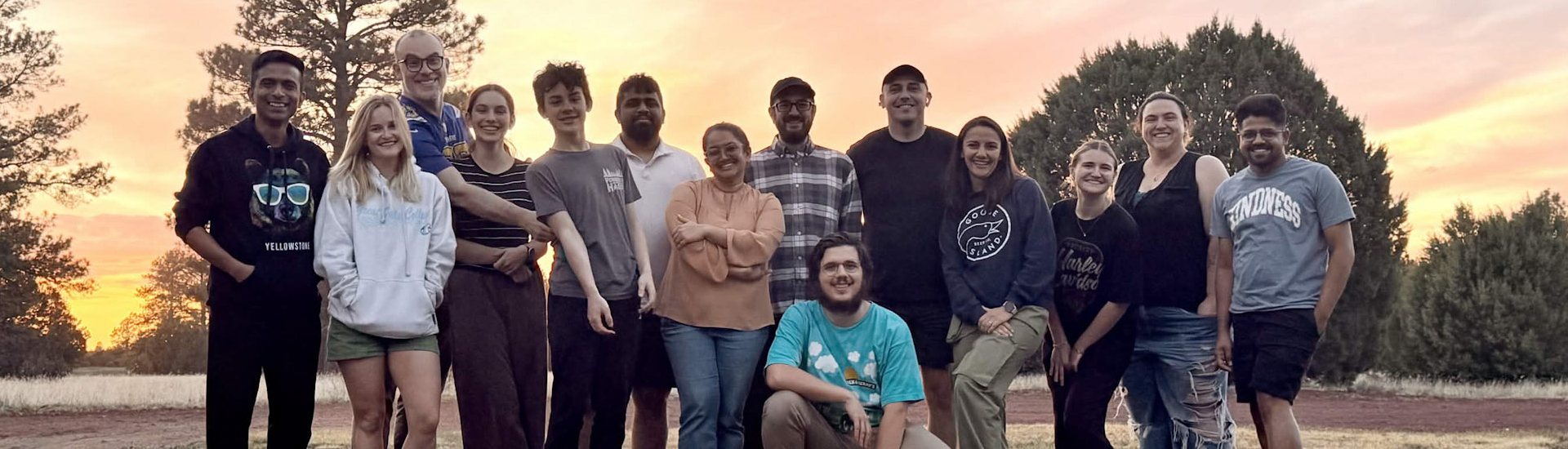
On May 12 at the High Country Conference Center, Northern Arizona University’s (NAU) Playful Health Technology Lab (PHT Lab) hosted its inaugural Hozhoni Gameorama, a collective community research event where individuals engaged with research and technology in the form of games.
The PHT Lab is a research group affiliated with NAU’s School of Informatics, Computing, and Cyber Systems. The lab and its researchers design and study accessible, interactive technologies aimed to better understand and improve health among rural populations and people with disabilities. Research technology includes speech therapy tools, mental health interventions, rehabilitation technologies, and more.
In partnership with the Hozhoni Foundation, the event brought researchers, students, adults with intellectual and developmental disabilities, and their caregivers together to play and test the lab’s seven newly developed technologies to see how they can improve disabled individuals’ lives, whether that be through accessibility or communication.
The Hozhoni Foundation supports people with all kinds of disabilities, including intellectual, physical, and developmental. One aspect of the foundation’s mission is to enhance quality of life and self-respect for individuals with disabilities through personalized services and engagement from respective communities.
Jared Duval, an assistant professor at NAU’s School of Information, Computing, and Cyber Systems and the director of the PHT Lab, led the event. He said the event was perfect timing for his students and an efficient way to showcase the projects.
“I was thinking about what is the most time-effective, cost-effective way to push all of these projects forward,” Duval said. “One of the things was having my students working over the summer. I need them to have data to be able to write publications, and so this was the perfect timing.”
Recently, Duval received a two-year, $300,000 Flinn Foundation Faculty Fellowship. This fellowship will help support his efforts with the lab and its work to prepare for larger-scale federal funding opportunities.
“The event is a way to sort of push forward all of the initiatives in my lab all in one day with a community partnership that I’m trying to strengthen and build,” Duval said. “And so it’s a mutually beneficial event for that.”
Event participants were able to experience seven technology stations featuring demonstrations, hands-on activities and collaborative workshops. Each station allowed participants to engage with current technologies and provide feedback to help brainstorm improvements to the technology.
SpokeIt, NetGauge, AutMotion Studios, Immergo, CardioCare Quest, Project Sunrise, and Robomoji were the seven technologies showcased at the event.
SpokeIt is a speech therapy game designed to support speech development through speech recognition. NetGauge, a game-based broadband mapping project, encourages participants to collect internet data from rural populations to support digital equity. AutMotion Studios is an exergame made for autistic individuals that combines play and movement. Immergo, a virtual reality physical rehabilitation project, works in partnership with an external startup.
CardioCare Quest was created for Indigenous communities because it uses culturally responsive mini-games and educational activities to support hypertension intervention and self-management. Project Sunrise is a health game app focused primarily on supporting Indigenous youth. Robomoji, a new collaboration with Tufts University, explores how robot arms can be controlled using inputs solely formed with emojis. The goal is to make robotics more expressive and accessible.
Duval explained that in order to make the event more accessible and fun, he and his team of student researchers came up with ideas to increase interest. They added traffic lights at each of the seven stations, where a green light meant the researchers were ready for the next participant to come test out their technology. Duval also said each participant got a “passport” to scan at each booth, to track the engagement and interest.
“They’re going to be able to go to the stations in any order at any time,” Duval said. “And so to track all that, I think that the passport system is pretty cool.”
The partnership between both the PHT Lab and the Hozhoni Foundation has developed over time through grant work and engagement efforts, allowing people to be involved in the programs and the events they host.
The Hozhoni Gameorama focused on its emphasis in co-design and community partnership. Duval said the event was intentionally designed for participants to share ideas, feedback, and personal experiences with one another. He said the event will have an impact not only on participants, but researchers too.
“I really want all the participants to enjoy a day of playing games, helping us design games, lots of good food, lots of giveaways and swag,” Duval said. “I want them to see NAU and my lab as supporting their goals too.”
Duval plans to host Gameorama yearly with continued partnership with the Hozhoni Foundation. To learn more about the work of the Playful Health Technology Lab, email SCE@nau.edu.
About the Steve Sanghi College of Engineering
At Northern Arizona University’s Steve Sanghi College of Engineering, students are prepared to solve real-world challenges through hands-on learning, interdisciplinary collaboration and strong industry partnerships. The college is committed to developing future engineers and technology leaders who can meet the demands of a rapidly evolving global workforce.